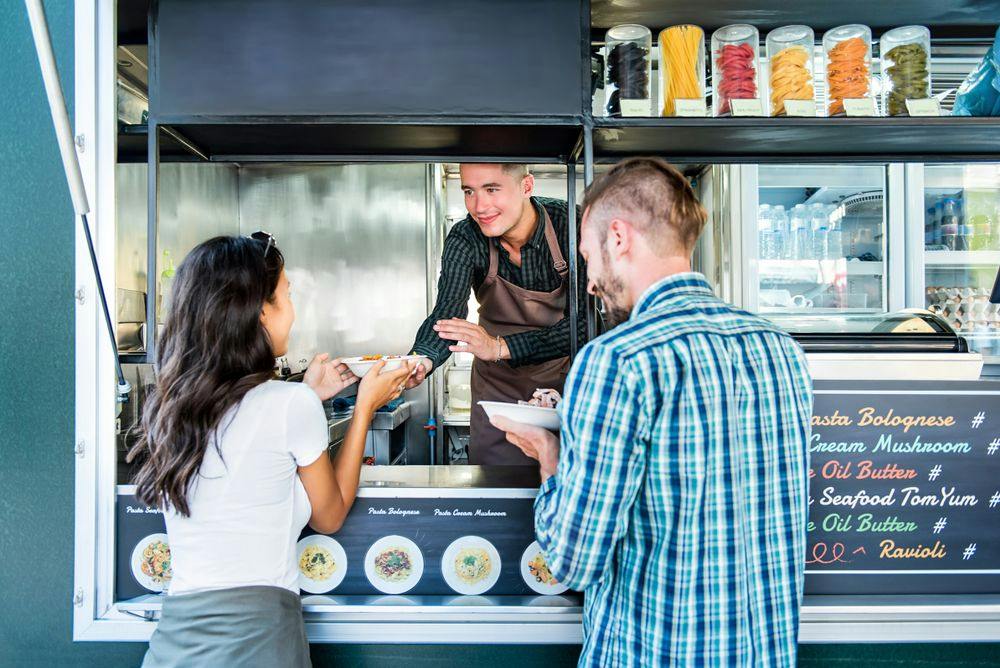
Both work. They're just good at different things, and the mistake companies make is picking the one that's better at events and then asking it to be a habit.
Our CaterCow team are experts at feeding teams weekly. If you're deciding how to feed a team every Friday and are considering a weekly on-site food truck, here's some considerations:
The short version
| Food truck | Delivered restaurant catering | |
|---|---|---|
| Best at | An event people remember | A reliable weekly default |
| Typical cost/head | $12–15 taco, $15–25 pizza/BBQ/burger | $10–20 depending on format |
| Hidden costs | Urban premium (+12.5%), weekend premium (+17.5%), parking, power, permits | None beyond the food |
| Throughput | One truck per ~150 guests, served in a window | Everything arrives at once |
| Weather risk | Real — it's an outdoor line | None |
| Hybrid-friendly | Poor (people have to be there, in the window) | Good, especially boxed |
| Dietary coverage | One truck, one kitchen, one cuisine | Rotate formats; per-person labeling |
| Admin per week | Booking, site access, coordination | Reorder or auto-submit |
Where the money actually goes
Our own food truck cost calculator puts a taco truck at $12–15 per person and pizza, BBQ, or burger trucks at $15–25 per person, based on a two-hour service window with one truck per roughly 150 guests. Add +12.5% for urban and metropolitan locations and +17.5% for weekends.
So a truck isn't wildly more expensive per head than good delivered catering — the per-person numbers overlap. The difference shows up in everything around the food.
A truck needs somewhere to park that's close enough to your entrance to be usable, and often power. Depending on the city and whether it's operating on private property or a public street, there may be permitting and site-access requirements to clear — and those are questions your facilities team has to answer every time, not once. Then there's the two-hour window: everyone has to be available inside it, which is a real constraint if your team runs back-to-back meetings or works across time zones.
Delivered catering has none of that. Food arrives at a time you choose, in your building, and the compliance surface is smaller because nobody is operating a vehicle or serving on your property.
Where a truck genuinely wins
Don't let anyone talk you out of a truck for the right occasion:
- It's an event, not lunch. A company family day, a summer party, a milestone, an open house. The truck is the entertainment.
- You want the spectacle. Food made in front of people, on the spot, with a line and a vibe. Delivered trays don't replicate that.
- You've got outdoor space and good weather. Phoenix in March, Austin in October — lean in.
- One cuisine, done well, is the point. A great taco truck is a great taco truck.
For a company family day specifically — kids, spouses, a couple of hours outside — a truck is often the better call than anything delivered.

Where food trucks fail for weekly programs
Weather. An outdoor line is fine 40 weeks a year in some cities and 20 in others. A recurring program needs to work every week, including the bad ones.
Throughput. One truck serves roughly 150 guests well. A 200-person site means two trucks or a long line, and "long line" is how a perk turns into a complaint.
Dietary coverage. One truck is one kitchen running one menu. The gluten-free, dairy-free, and vegetarian members of your team are all negotiating with the same window, and there's no per-person labeling — you're relying on people asking the right questions at the counter.
The window problem. Delivered lunch waits for the person stuck on a call. A truck leaves at 1:15.
Repetition. Your team will love the taco truck. They will love it slightly less the fourth Friday in a row, and the same truck can't rotate cuisines the way a rotation of local restaurants can.
Admin. Booking, confirming, site access, and coordination, every single week.
What we actually run — and the honest answer to "which do you use?"
CaterCow is delivered catering from vetted local restaurants. We're not a food truck operator and we're not a single central kitchen: your office orders from restaurants already proven in your city, and it's delivered to your floor either family-style or individually boxed.
For a recurring program, that's a deliberate choice, and the reason is mostly boring reliability. Restaurants get vetted with test deliveries — we track how orders actually arrive, packaging, and track punctuality and service before they stay on the platform. A weekly program lives or dies on the fourth week and the fortieth, not the first.
The practical shape of recurring meal programs:
- Cadence you pick — one-off, monthly, every other week, or every week.
- No contracts and no minimum spend, so a light week costs less rather than costing you a penalty.
- Rotation across cuisines and formats, so the program doesn't wear out.
- Per-person labeling with employee name, food description, and dietary tags when you go boxed or use group ordering.
- Account managers who can take the menu and the restaurant logistics off your plate entirely.
If you want the truck energy without the truck, the closest thing is a build-your-own bar — made-to-order feel, assembled by each person, no parking required:
The combination most companies land on
The answer usually isn't one or the other:
- Weekly: delivered catering from a rotation of local restaurants. Reliable, hybrid-friendly, covers dietary needs, minimal admin.
- Quarterly: a food truck for the thing you want people to remember — the family day, the summer party, the big milestone.
That way the truck stays special instead of becoming the thing people have opinions about.

Food Truck vs. Catering FAQs
Is a food truck cheaper than catering for an office lunch?Not meaningfully. Our own figures put taco trucks at $12–15 per person and pizza, BBQ, or burger trucks at $15–25, which overlaps with delivered catering. The cost difference is in logistics, not food.
How many people can one food truck serve?Plan on one truck per roughly 150 guests for decent service inside a two-hour window.
Do food trucks work for a hybrid office?Poorly, as a recurring format. Everyone has to be onsite and available in the service window, and attendance in a hybrid office isn't predictable enough to book around weekly.
Can food trucks handle dietary restrictions?One truck is one kitchen with one menu, and there's no per-person labeling. For teams with real restrictions, a build-your-own bar or individually boxed meals is safer.
What about permits and insurance?Site access, parking, power, and permitting depend on your city and whether the truck operates on private property or a public street — worth confirming with facilities before booking. Delivered catering avoids most of it because nobody is serving on your property.
Do you offer food trucks?No — CaterCow is delivered catering from vetted local restaurants, family-style or individually boxed. For a weekly program that's the more reliable format; for a company party, book the truck.
Deciding
Ask one question: is this a habit or an event? Habits want delivered catering. Events want a truck.
Set up recurring group ordering for the weekly program, and price out the truck with our food truck cost calculator when the quarterly party comes around.